The parents are literally helicopters. They refuse to hover.
Mom and Dad land at most once an episode, say why, and lift off: “The rest is yours.” What six kid helicopters do with the rest is the show.
A lost mitten gets a searchlight.
Every kid is built for a real emergency. Hometown mostly has Tuesdays. So a stuck kite gets a nine-step rescue plan, a late library book gets a police report, and Dad covers both live.
How far can you fly alone?
An old trolley route board glows on the wall of the family’s barn, one circle per kid. Every kid is sure their circle is too small. Circles grow by judgment, never heroics.
Kids come for the rotor wash. Parents stay for the parents.
- Rotor wash. Hats, pies and the neighbor’s newspaper all take flight. The whole town bungee-cords its life to the porch.
- Six kids, one bay door. They race, bicker, cut the line, tattle in police codes, and launch on “one” when everyone agreed on “three.”
- Dad on the air. He narrates a missing sock like breaking news. The smaller the news, the longer the pause. When he skips the pause, it’s real.
- Parents who lead without hovering. Real room, a clear why, and one landing when it counts.
- A Mom whose brain works differently. Loud surprises scramble her; sudden plan changes jam her rotors. She says so: “I’m at forty percent today. Nobody has to fix it. It’s a weather report.” She’s still the family’s most capable rescuer.
- The dinner table. Three to five versions of the same day, none matching, and the one who missed it gets the last word.
Community over heroics.
Helicopters have no hands. The kids get the problem close, and a person with hands finishes it. Nobody saves the day alone — that’s the point, and also the plot.

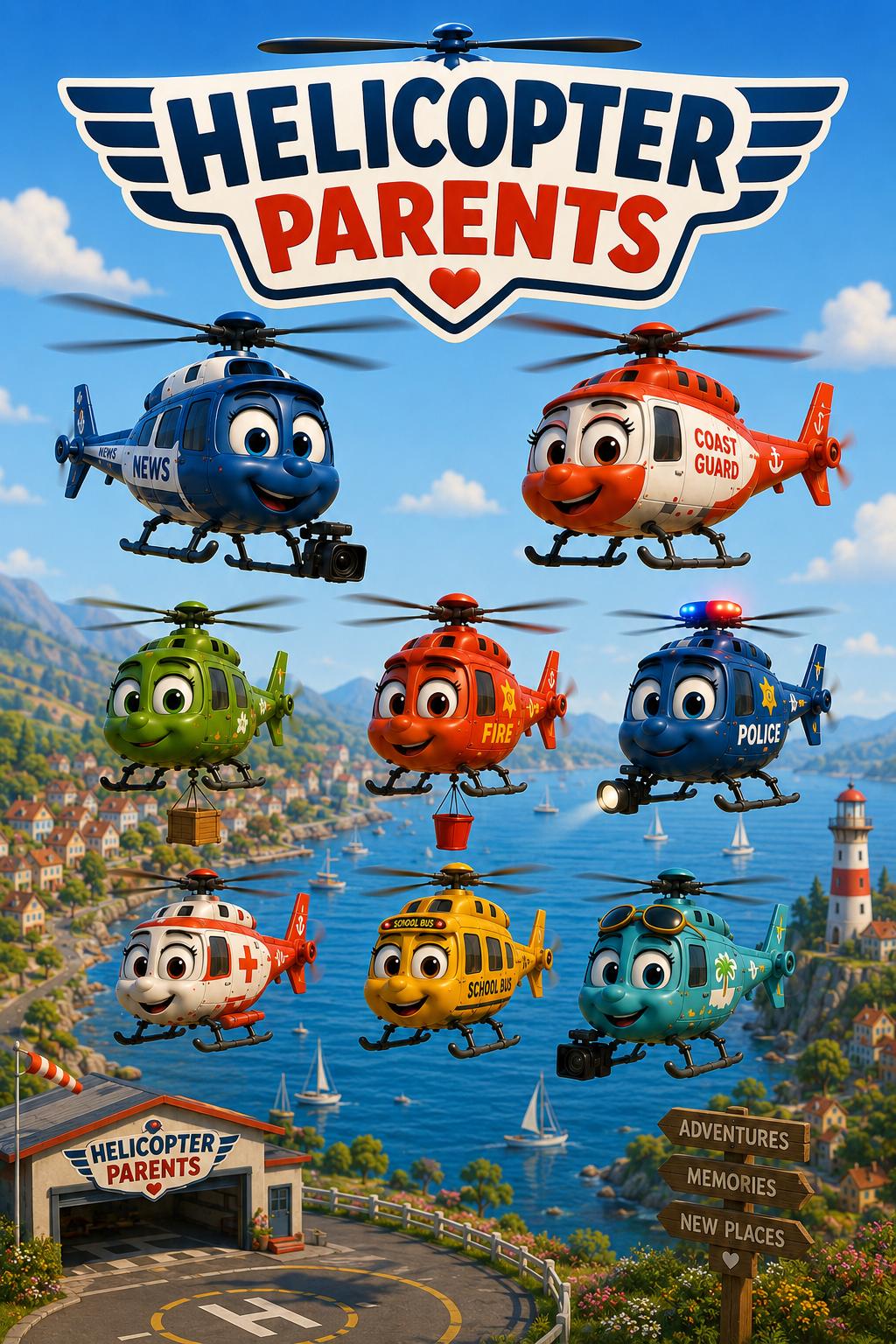
Eight characters, one glance.
The title, all eight characters and their jobs in one image.
A foggy harbor town where the sky is one more street.
Every neighbor in Hometown is better at their job than the helicopters are. Nobody in Hometown thinks the family is strange. Everybody thinks they’re loud.

Three landmarks, all of them in the way
- The Barn. The family lives in the town’s old brick trolley barn, bought for one dollar and a promise to keep the route board lit. The board is now the Range Map. Dinner happens on the old trolley turntable.
- Lucille. A 1931 drawbridge. Bev has run her for forty years and talks to her like a stubborn coworker: “Lucille. We talked about this.” Her lift zone is off-limits sky, so every flight path bends around her.
- Juniper Street. Too narrow to lift off, so at 6:58 every morning all eight taxi down it in birth order: the Shuffle. Harlan, a retired air-traffic controller two doors down, times them and files a complaint, with a new number every morning. In the pilot: “Four seconds early. Complaint Four-Seven-Five.” … “Have a pleasant day.”
- Fog grounds the kids. Storms ground everyone.
- Rotor wash is Hometown’s weather. Tablecloths are weighed down with bricks, and the pie stand has a sign: NO HOVERING OVER THE PIES.
- Weight, noise and landing space are real limits. A helicopter can spot the problem first and still need a person to fix it.
- Bev runs Lucille. Nobody hovers over Bev.
- Cecil drives the Route 6 school bus and announces disasters like light drizzle: “Folks, we are experiencing a bridge.”
- Sgt. Branch answers Ziv’s made-up rule numbers with real ones.
- Mr. Lin, the librarian, shushes rotors.
- Harold from Ohio came as a tourist and never left.
Each one built for an emergency. Each one stuck with Tuesday.
Two parents and six kids, each a different working aircraft with a different job. Meet them through Tzohar, the youngest: he notices everything, and nobody waits for him to finish.
Five beats, one pile-up, and dinner. Always dinner.
Every 11-minute episode runs on the same engine: a small town problem, the kids making it bigger, a person with hands finishing it, and eight helicopters landing for dinner.
Somebody’s job breaks
A bridge sticks. A bus route jams. A freezer quits. The problem always belongs to a real person who is good at their job.
Five kids, five different fixes
One of the eight is always somewhere else, so it’s usually five kids, and each one’s equipment shows them a different problem. They fix different ones at once. At least two are partly right. Someone always makes it worse.
Three versions of one day
Dinner is where the day becomes a story the family tells about itself — three ways as a rule, five at most, and none of them match. The one who missed it is about to hear every one.
Meanwhile: the one who sat it out
One of the eight misses the whole adventure. We catch their day in three ten-second glimpses: a pattern, the pattern again, a twist. At dinner they react louder each time — “There were HATS?” — until someone asks where they were.
“Can’t a helicopter get a break?”
Or, on a day that was officially theirs: “Can’t a helicopter get a day off?” Cut to black. The one who sits out rotates, parents included.
One stuck bridge. Ten more disasters. Nineteen bedtime stories.
The pilot shows the whole machine running. Ten more episodes show it breaking in ten directions. And the creator’s nineteen original bedtime stories, written before the series, sit at the bottom as pre-series drafts.

The Stuck Bridge
Tzohar’s first morning with a bigger circle. He may guide the tour boat from the harbor walk, just not past Lucille. By lunch he has spotted the problem. By dinner, somebody has listened.
- The clue: at 9:16 a.m., the man with the camera snaps a yellow maintenance bar on Lucille’s ledge. Tzohar’s own shot is a smudge, and nobody waits for him to finish.
- The jam: at 3:10 p.m., Lucille sticks halfway up. Cecil’s Route 6 bus is first in line with twenty-two kids, their grown-ups wait on the far bank, and Marcus really needs a bathroom.
- The pile-up: Shiraz bets Remez the wash rack, one week, on who reaches Lucille first. Remez’s overpacked sling won’t lift until he drops his crates: “Snacks: optional.” Shiraz’s braking flare blows forty tourists’ hats into the harbor. “What hats?”
- Mom’s landing: Shiraz is about to hook her bucket line to the jammed steel. Mom lands — once: “That’s Bev’s bridge, and that’s a safety call.” Then she lifts off: “The rest is yours.”
- Three tries: Tzohar tells Remez (“Not now. I’m on step four.”), then Shiraz (“Not NOW!”), then Dad, live on air: “Not now. That’s my son, folks, he’s fine.”
- Dad’s landing: Shiraz has hidden a pile of hats behind the bait shack. Dad lands once, tally light off: “Forty hats is an accident. Hiding them isn’t.” She tells the harbor boss herself.
- Human hands: at the edge of his circle, Tzohar doesn’t cross. Tzila asks the plain question, “Different how?”, and he finds someone with feet: the man with the camera. Bev’s crew lifts the bar out by hand.
- The crossing: “Folks, we have arrived. Marcus: go.”
- Dinner: Zeri spent the day at the hospital, counting ceiling tiles with a scared little girl. “There were HATS?” … “A detour?” … “A SEAL?” Then Tzila: “Zeri. Where were you?” “Can’t a helicopter get a break?”
The original bedtime stories
Where the show started: nineteen stories written to be read aloud at lights-out, before the series had its rules. They’re kept exactly as written, so expect hands, snacks and a phone game the show itself doesn’t allow. The episodes above are the show; these are its first drafts.
Six of the nineteen bedtime stories — the other thirteen are ready when you are.
Every circle grows. The clock stays slow.
Three seasons of 26 × 11 minutes, each season asking one question. By the last dinner, every circle on the Range Map is lit.
The Range Map
How far can you go on your own, and who do you need when you get there? Every kid’s circle grows once. Harlan’s complaints climb to #500 and put the morning Shuffle on trial: a 6:45 a.m. hearing on Juniper, everyone in bathrobes.
Hometown Time
What’s worth keeping when a town changes? The county wants to automate Lucille, and the council wants to “fix” the town hall clock, which has run four minutes slow for seventy years. Cousin Drone, a quadcopter with his own news show, beats Dad to every story: “DroneCast! First! Live! Extremely close!” The clock stays slow on purpose.
Home Pad
When every circle keeps growing, what brings you home? A storm grounds everyone, and the heroism is the preparation. Remez flies his first solo past the town line. At the last dinner, every circle is lit, and Mom, who sat the day out by choice, gets the last line: “Can’t a helicopter get a day off?”
What each kid learns across three seasons
Real machines first. Faces second.
The design test: hide the faces, and a five-year-old should still be able to name all eight jobs. Polished 3D with softened realism: painted metal, dents, harbor haze, golden hour.
Navy and warm orange: a harbor at dusk, a rescue light at night.
No hands, ever. Eyes, pitch, hover rhythm and rotors do the acting.
- Kids up front, parents back and low. The camera frames Mom and Dad the way they parent: present, not hovering.
- A sound mix with quiet in it. Loud moments are always telegraphed, so nobody on the couch gets ambushed.
- The five-second rule: a glance at any poster should say “that’s a family, and they all have different jobs.”
The show is in development. The game is not.
Pick a flyer. Pick an adventure. Keep Hometown running.
Eight adventures set in Hometown, playable in a browser. Three come from the series: Shiraz scooping Forty Hats out of the harbor in the pilot, spotting a ferret in Route 6’s windows in Judge, and flying wing on Mom’s Friday challah run in Calling Wing. Five more come from the creator’s pre-series bedtime stories.
Wanted: a producer and a head writer. Helicopters provided.
An experienced kids-animation producer or production partner, someone who has taken a show from pitch to screen, to package Helicopter Parents for the people who greenlight shows. And a head writer with 11-minute ensemble credits.
- The full series bible: world, family, episode engine, three season arcs and 73 springboards
- The pilot script, The Stuck Bridge (revised draft, October 2026)
- Nineteen original bedtime stories (pre-series drafts)
- Nineteen storyboarded shorts and seven bumper series
- A playable game: Hometown Adventures
- Early concept art
The person behind the family of eight.

Jacob Sager
Writer and father of six. The show started as bedtime stories.
Jacob believes in storytelling and children’s TV — stories that trust kids with real capability, find the comedy inside family life, and treat a town as something worth understanding.